 Camera Sudoku
Naked Pair in Sudoku: how to spot it and use it
A Naked Pair in Sudoku is two cells in the same row, column or box that both have exactly the same two candidates, for example 3 and 5. One of those cells must be 3 and the other 5, so neither digit can go anywhere else in that row, column or box, and you can remove both from every other cell there. It is usually the first technique you need after singles.
Why a Naked Pair works
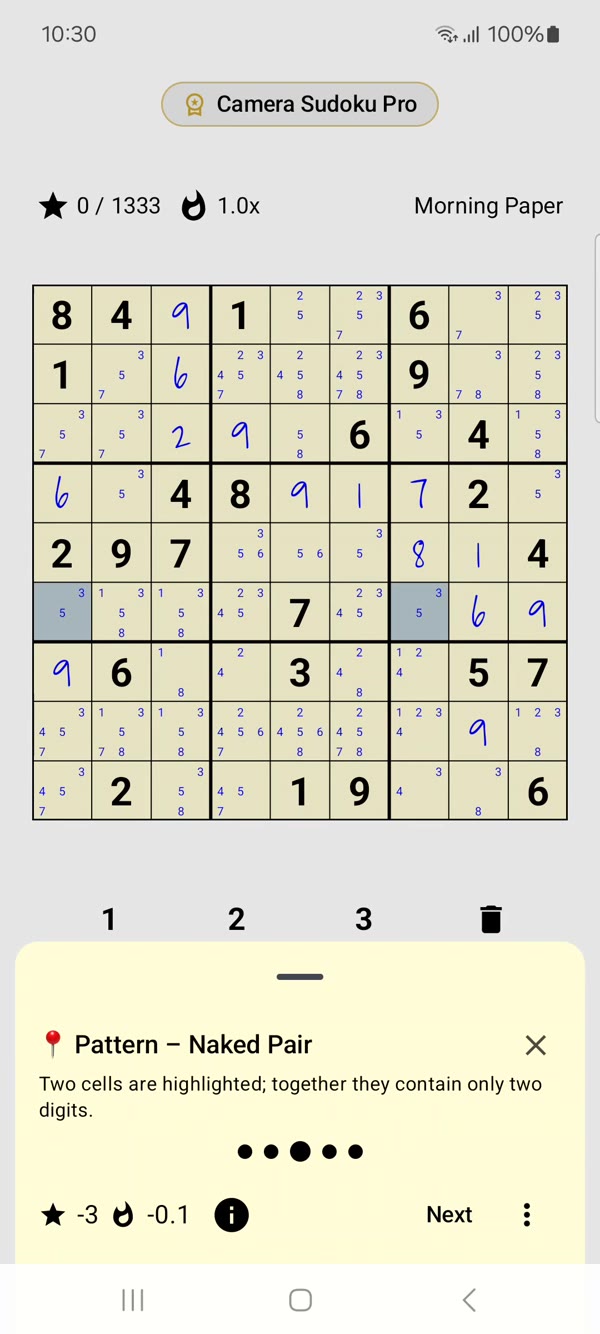
Take two cells in row 6 whose only candidates are 3 and 5. Whatever the solution is, one of them holds the 3 and the other the 5; there is no third option. Row 6 needs exactly one 3 and one 5, and these two cells use them up. Any other 3 or 5 in row 6 would be a second copy, so those candidates are false and can be crossed out.
The same holds in a column or a box. If the two cells share both a row and a box, you can eliminate from both.
How to find a Naked Pair
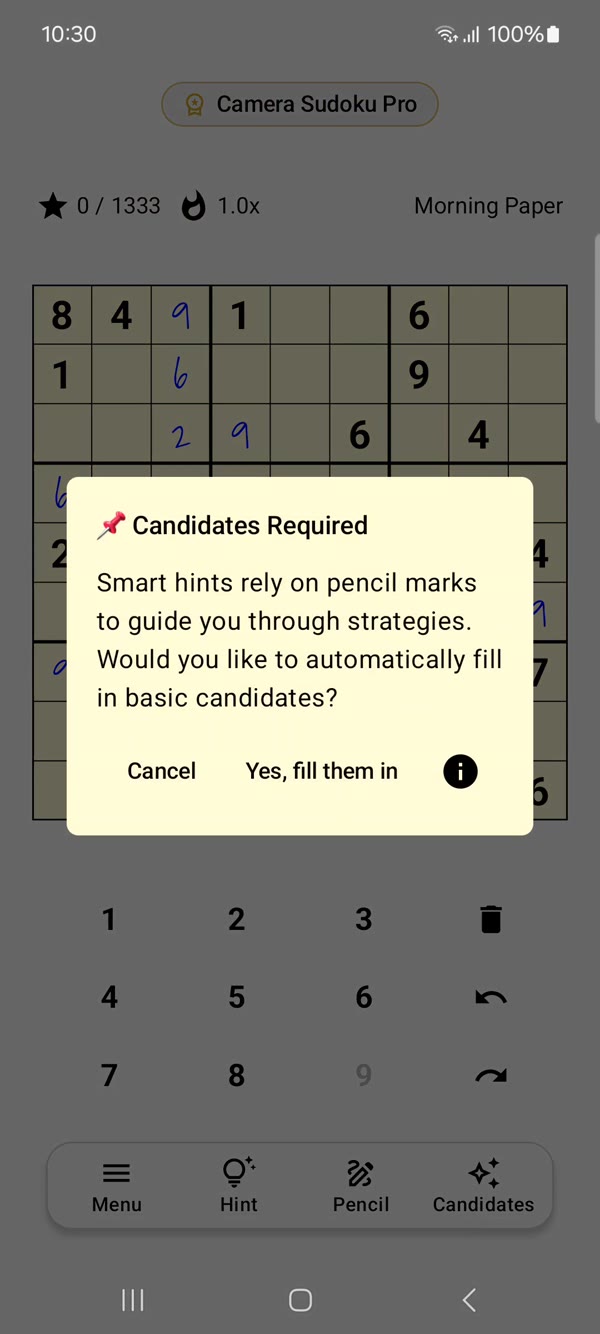
- Fill in candidates. You can't see pairs without pencil marks. Camera Sudoku can fill the basic candidates for you.
- Look for cells with exactly two candidates. Scan one row, column or box at a time.
- Find two identical ones in the same unit. {3,5} and {3,5} is a pair; {3,5} and {3,7} is not.
- Eliminate. Remove both digits from every other cell in that unit. Leave the pair itself alone.
The example, stage by stage
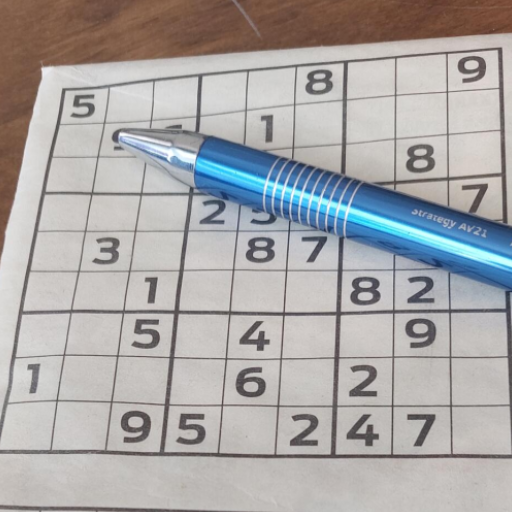
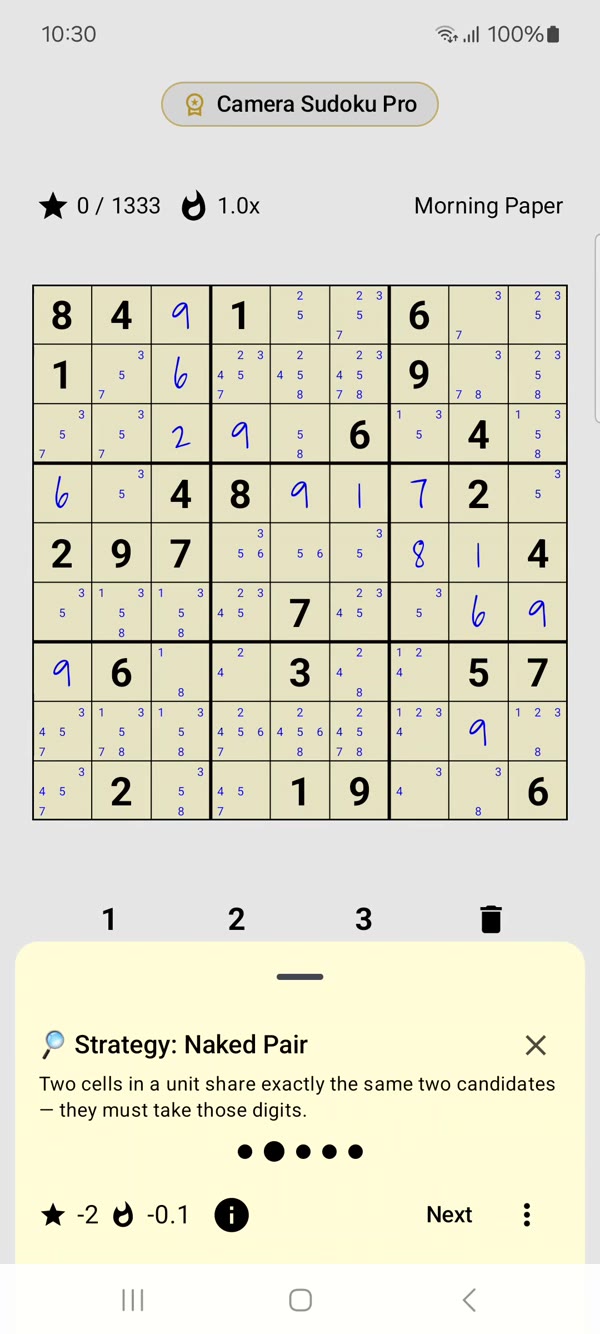
In the recording, the puzzle is the newspaper Sudoku scanned in the scanning guide. In row 6, the first and seventh cells are the only ones with just 3 and 5 as candidates. Smart Hint highlights those two cells first, then marks the 3 and 5 inside them.
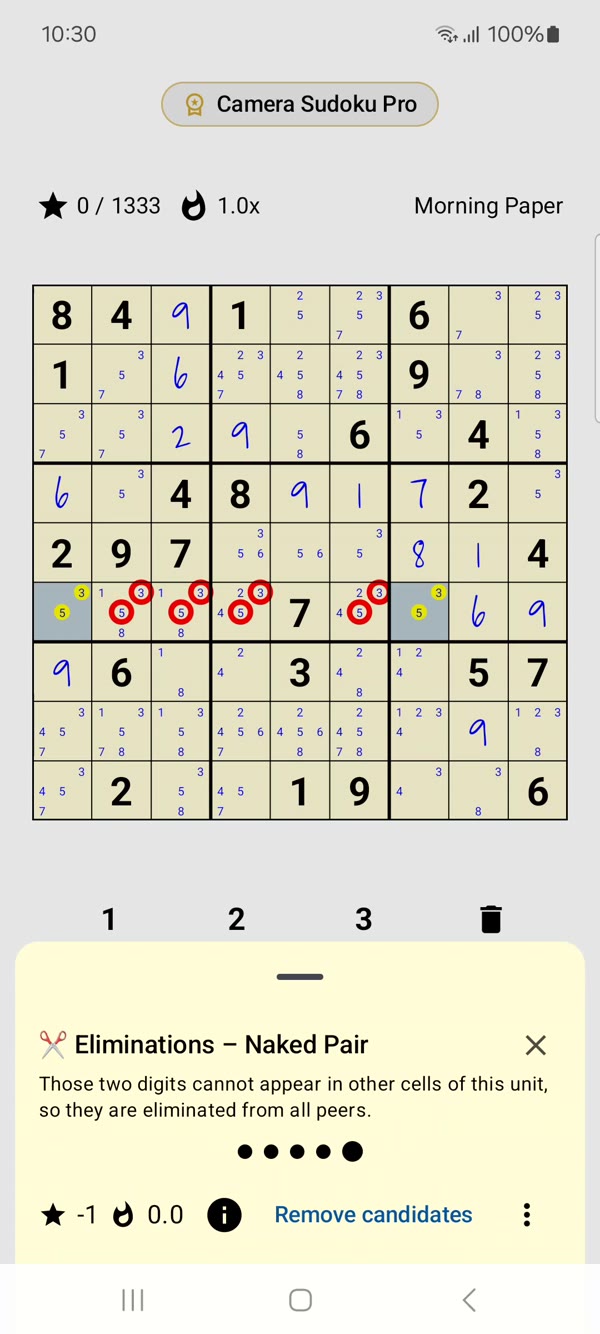
Four cells lose candidates: two drop from {1,3,5,8} to {1,8}, and two from {2,3,4,5} to {2,4}. Notice what that leaves: two new Naked Pairs in the same row, {1,8} and {2,4}. One elimination often sets up the next.
Naked Triples and Quads
The idea scales. A Naked Triple is three cells in one unit whose candidates, taken together, are only three digits. Each cell doesn't need all three: {1,2}, {2,3} and {1,3} is a valid triple, because those three cells must hold 1, 2 and 3 between them. Remove those digits from the rest of the unit. A Naked Quad is the same with four cells and four digits.
Naked Pair vs Hidden Pair
A Naked Pair is two cells with nothing but the same two candidates. A Hidden Pair is two digits that can go in only two cells of a unit, even though those cells have other candidates too. In a Hidden Pair the two digits claim the cells, so you remove the other candidates from those two cells. Smart Hint finds both, and names which one it is.
Using Smart Hint for pairs
Tap Hint when you are stuck. The first stage only names the technique, which is often enough: once you know to look for a Naked Pair, finding it yourself is good practice. Each further stage costs a little more score. At the last stage, Remove candidates applies the eliminations at no extra cost.
Common mistakes
- The cells aren't in the same unit. Two {3,5} cells in different rows, columns and boxes tell you nothing.
- One cell has a third candidate. {3,5} and {3,5,8} is not a Naked Pair, although it might be part of a triple.
- Missing pencil marks. If you skipped a candidate when marking by hand, you can see a "pair" that isn't one. Automatic candidates avoid that.
Frequently asked questions
Does a Naked Pair have to be in a box?
No. It works in any row, column or box. If the two cells share both a row and a box, you can eliminate the digits from both.
What is the difference between a Naked Pair and a Hidden Pair?
A Naked Pair is two cells with only the same two candidates; you remove those digits from the rest of the unit. A Hidden Pair is two digits that fit in only two cells of a unit; you remove the other candidates from those two cells.
Do I need pencil marks to find Naked Pairs?
Yes, pairs are only visible in candidates. Camera Sudoku can fill in the basic candidates for you and keep them updated as you place digits.
Ready to try it?
Camera Sudoku is free to install. Scan your first puzzle in seconds.