 Camera Sudoku
Sudoku solving strategies, from singles to chains
Sudoku is solved with a small set of logical techniques, applied from simplest to hardest. Camera Sudoku's Smart Hint always looks for the simplest step that works, shows it on your grid, and names the technique. Here is that ladder in plain language, so you know what each hint is teaching you.
How a Smart Hint unfolds
A hint does not jump straight to the answer. It opens in stages, and you can stop at any stage and finish the step yourself:
- Strategy names the technique, for example Naked Pair, and says what it means.
- Pattern highlights the cells that form it.
- Candidate Logic marks the candidates that make the pattern work.
- Eliminations circles what can be removed, or the digit that can be placed. Remove candidates then applies it for you.
Hints work on candidates (pencil marks). If the board has none yet, the app offers to fill in the basic ones. Each stage you open lowers the maximum score a little more, so stopping early pays.
1. Singles: where most puzzles are won
- Naked Single: a cell has only one possible candidate left. Place it.
- Hidden Single: a digit can go in only one cell of a row, column or box, even if that cell has other candidates.
Easy and medium puzzles fall to singles alone. Once you have the hang of them, Camera Sudoku can auto-fill singles for you.
2. Pairs, triples and quads
When two cells in a unit share exactly the same two candidates (a Naked Pair), those digits must go in those cells, so you can remove them from every other cell of the unit. Hidden Pairs work the other way round: two digits that fit only in two cells claim those cells. The same idea scales to triples and quads. Naked Pairs, step by step →
3. Pointing and claiming
If all candidates for a digit inside a box line up in one row or column, that digit can be removed from the rest of that row or column (pointing). The reverse, a row's candidates confined to one box, is claiming, also called box/line reduction.
4. Fish: X-Wing, Swordfish, Jellyfish
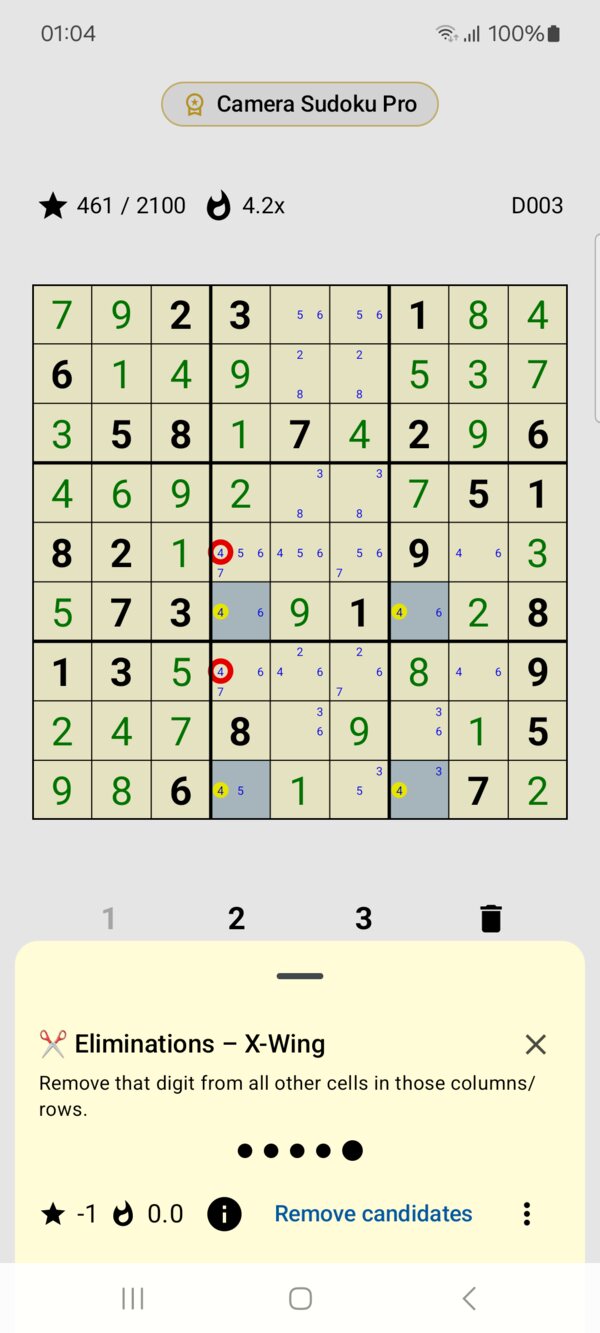
An X-Wing is a digit that appears as a candidate in exactly two cells in each of two rows, and those cells share the same two columns. The four corners form a rectangle, and the digit can be removed from the rest of those columns. Swordfish (three rows) and Jellyfish (four) are bigger versions. Finned fish allow one extra candidate near a corner. X-Wing, explained with an example →
5. Wings and short patterns
- Y-Wing, XYZ-Wing and WXYZ-Wing: a pivot cell and two or three "pincers" that together force a digit out of the cells they all see.
- Skyscraper and Two-String Kite: two strong links on one digit, joined at one end.
- Simple Colouring: follow a chain of strong links on one digit, alternating two colours, to find a contradiction.
6. Unique Rectangles
A proper Sudoku has one solution. Four cells in two rows, two columns and two boxes cannot all end up holding the same two digits, because the digits could then swap. Unique Rectangle hints use that rule to remove the candidate that would create this "deadly pattern".
7. Chains
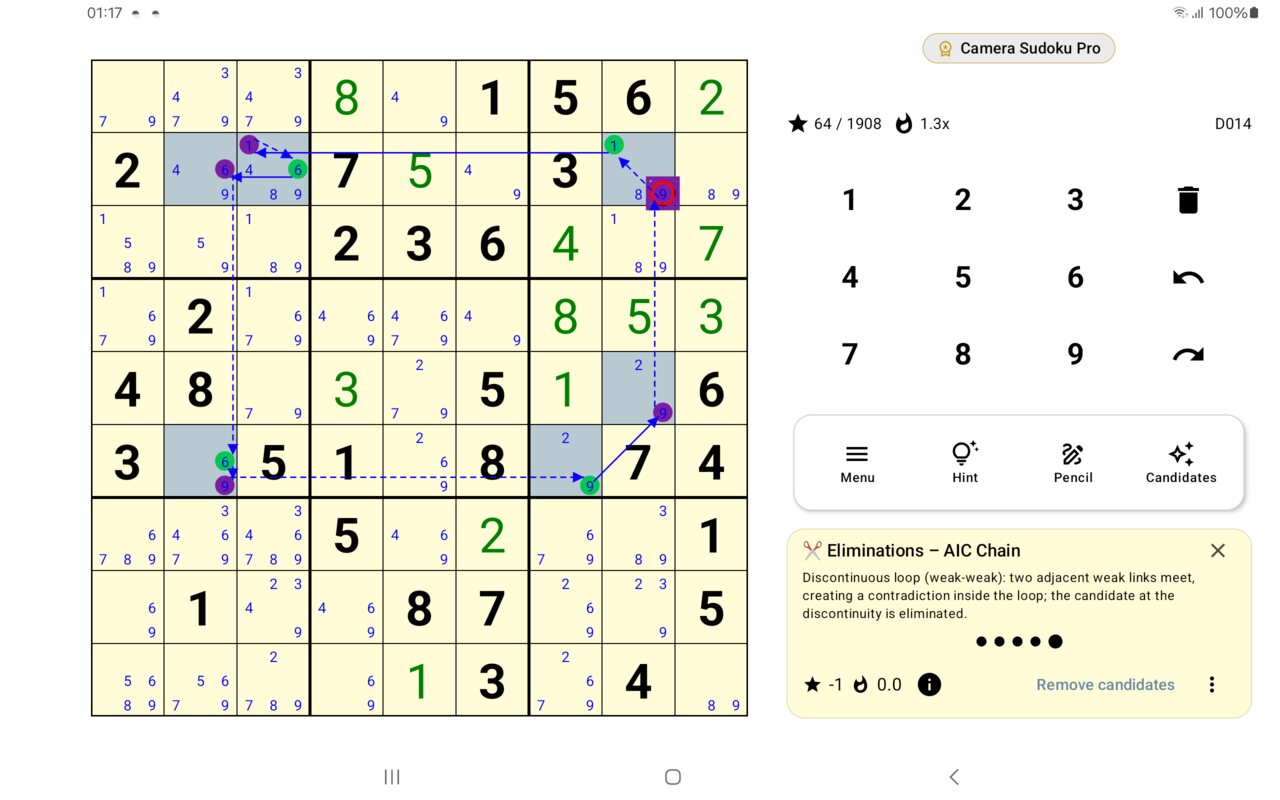
When nothing simpler works, Smart Hint builds a chain of alternating strong and weak links (X-Chains, XY-Chains and general Alternating Inference Chains) and draws it on the board, so you can follow the logic link by link.
How to practise
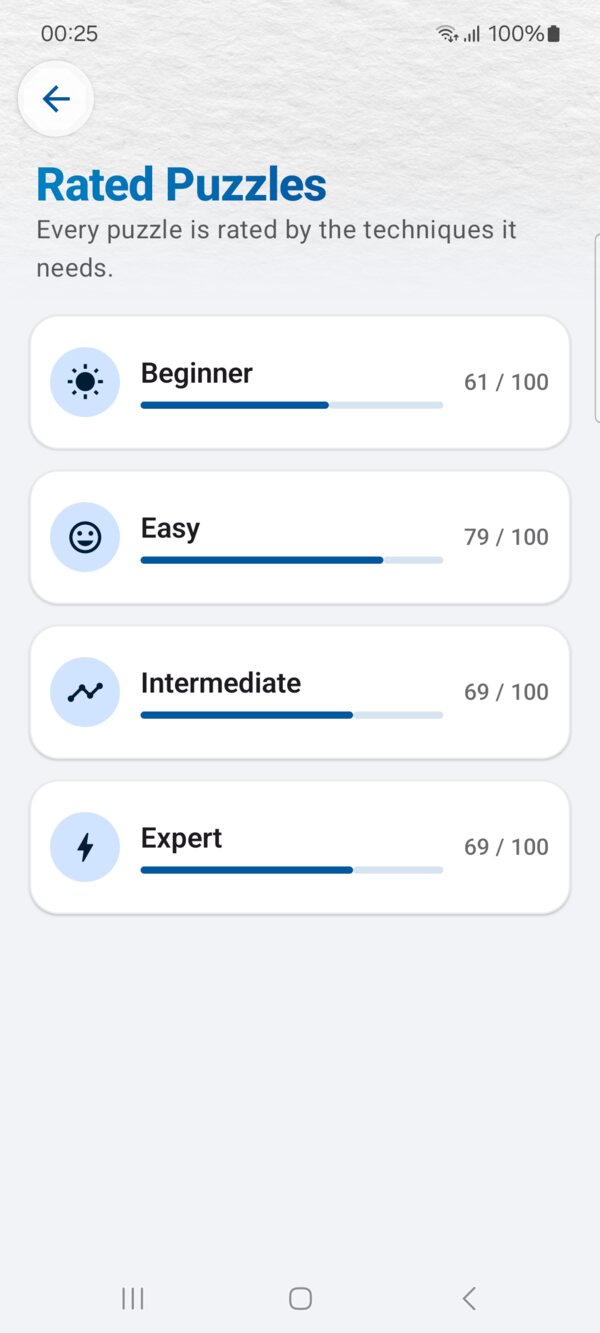
- Play a puzzle one level harder than feels comfortable. Every built-in puzzle is rated by the techniques it needs, from Beginner to Expert.
- When stuck, open only the first hint stage and read the technique name. Then look for the pattern yourself.
- Try to spot the same pattern on the next puzzle before asking again.
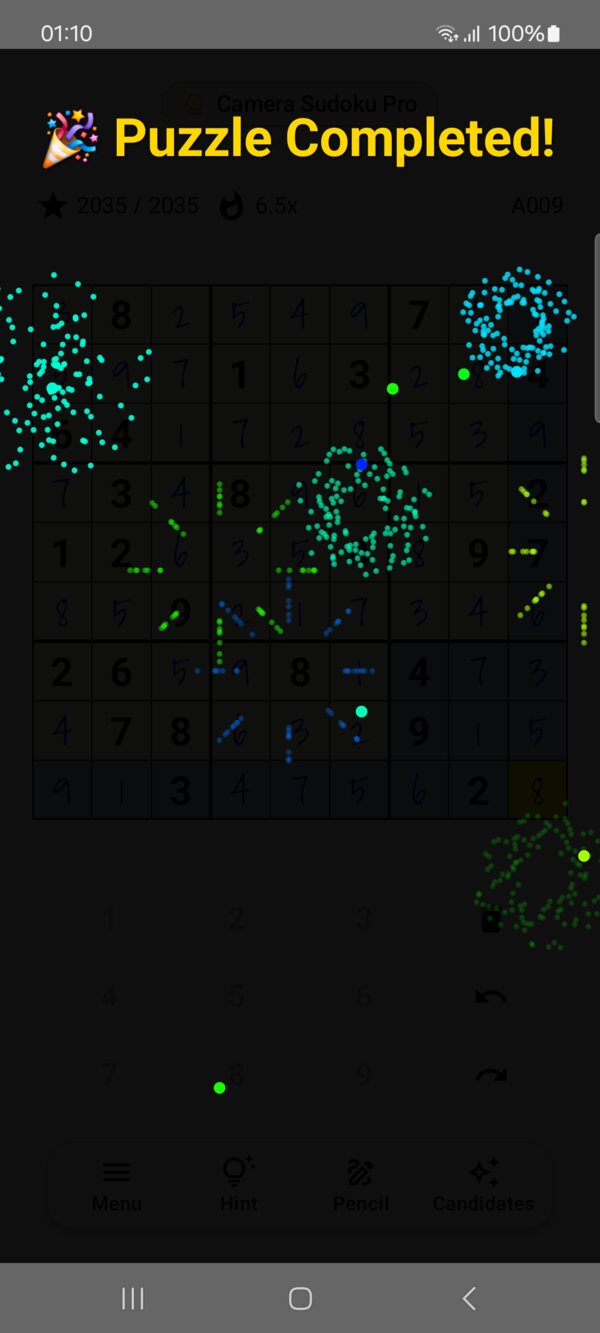
Hints lower your score multiplier, so solving unaided scores more. The Sudoku King trophy goes to a perfect solve with no mistakes, hints or checks.
Frequently asked questions
Which technique should I learn first?
Naked and hidden singles solve most easy puzzles. Then learn pairs and pointing; X-Wing is the usual next step for hard puzzles.
Does Smart Hint use guessing?
No. Every hint is a logical step with a named technique. If you want the answer anyway, you can reveal a single cell.
Do hints lower my score?
Yes, hints reduce your score multiplier, so solving unaided scores more. The Sudoku King trophy needs a solve with no mistakes, hints or checks.
Ready to try it?
Camera Sudoku is free to install. Scan your first puzzle in seconds.